by Suzanne Blons The Beauty Shaman
Diving into the world of topical vitamin C serums is like stepping into a buzzing beehive of anti-aging magic for your skin. Picture this: you’re on a mission to find the perfect vitamin C serum to turn back the hands of time and restore your skin’s youthful glow. But as you scan the shelves packed with promising bottles and try to decode the jargon spouted by eager salespeople, the overwhelm sets in like a stubborn cloud on a summer day.
You can practically hear your skin whispering, “Help! How do I choose the real deal from the imposters? How do I make sure my skin investment pays off?” And to add a twist to the plot, there’s not just one type of topical vitamin C – oh no, there are 7 to 8 different varieties dancing around, each claiming to be the golden ticket to radiant skin.
But fear not, dear reader, for in this article, we’re going to peel back the layers of confusion and shed light on the mysteries of vitamin C serums. By the end, you’ll be armed with the knowledge to pick the perfect potion for your skin type, and we’ll even share our top-secret recommendations for vitamin C skincare treasures across a range of prices and effectiveness. Let’s embark on this skincare adventure together, shall we?
The Secret’s in Quantity and Type!
If any of the types of vitamin C listed below (depending on the strength) has 10% or less vitamin C, you will see some brightening of your complexion, but in general not much improvement. With 15-20% of the ingredient you will notice more cumulative effects. Anything over 20%, and you have a much greater chance of seeing real results, but be aware, you will pay more.
Most brands do not put the percentage of ingredients in their marketing, so the best way to figure this out is by looking at the ingredient deck. The higher on the deck an ingredient appears, the greater the quantity. So if any of the types discussed in this article are number 15-20 on the deck, you’re not getting very much. More on this toward the end of the article where I explain what to watch out for.
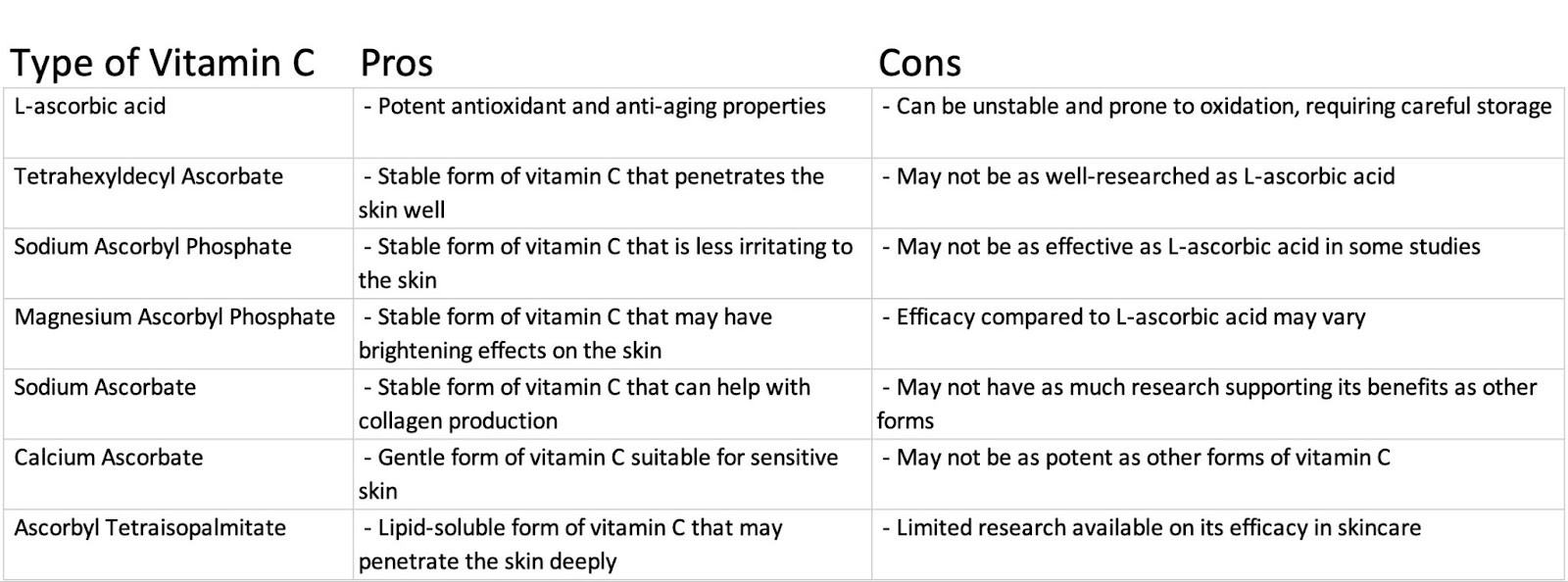
Table of Types of Vitamin C with Pros and Cons of Each
Here is a simple chart detailing the types of vitamin C and the pros and cons of each:
Let’s now get into each type, what they do, and our recommendations.
Ascorbic Acid or L-Ascorbic Acid
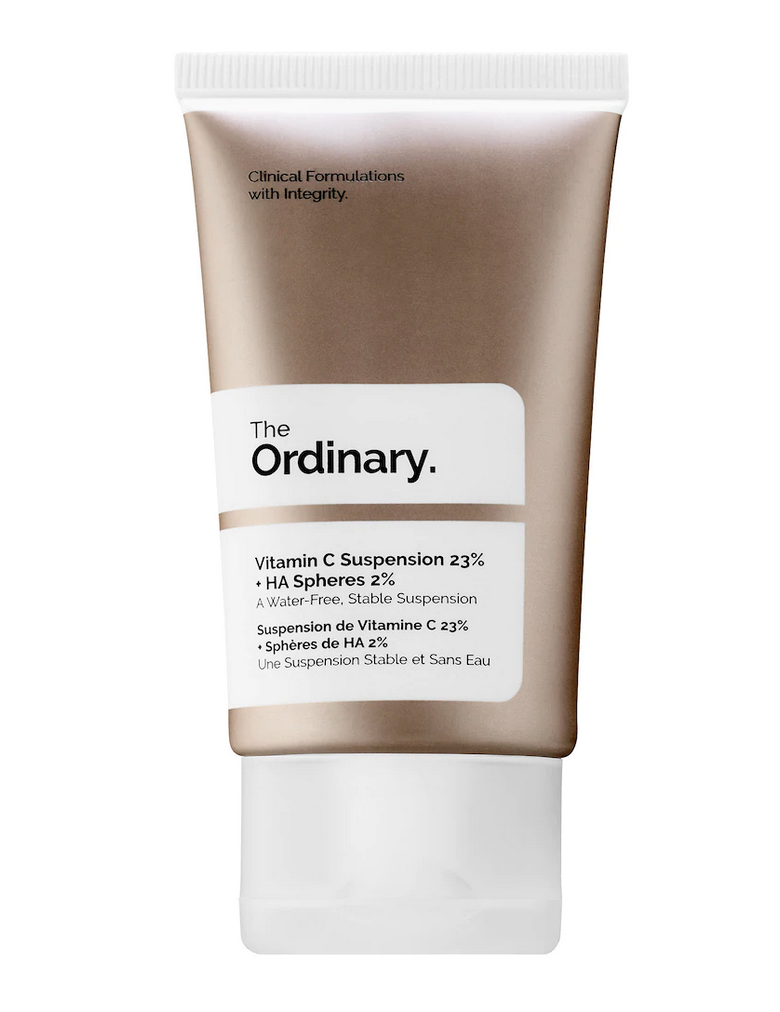
L-ascorbic Acid is by far the most well-known, least expensive, and most unstable type of vitamin C. It is water soluble, which means its ability to penetrate the top layer of skin (stratum corneum) is minimal. Because of this, it is not the only or most effective type, given current research. Having said that, the quantity of ascorbic acid used in a product, like every other ingredient, is a huge determiner of effectiveness.
What We Love: If you haven’t used l-ascorbic acid in vitamin C serum before, try The Ordinary Vitamin C Serum. It’s an inexpensive way to see how your skin reacts. But be aware, this product is a suspension, so it can be grainy and irritating, and less efficacious due it’s unadorned formulation. For beginners, though, it’s a great place to start. Cost $7.
Tetrahexyldecyl Ascorbate (THDA)
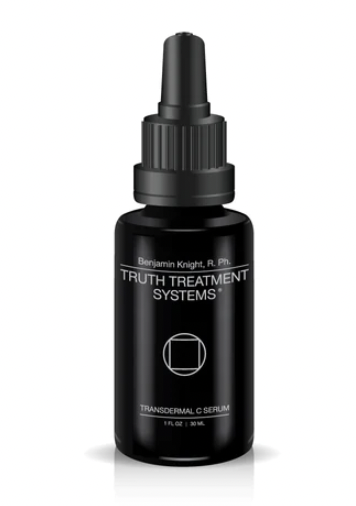
THDA is an oil soluble, highly stable form of vitamin C capable of deeply penetrating the skin’s top layer. Enzymes in the skin convert this form of vitamin C to pure vitamin C, or ascorbic acid. However, unlike ascorbic acid, THDA is lipid (fat) soluble. THDA and ascorbic acid absorb in much the same way, but THDA has fewer limitations in that it’s less irritating, stimulates more collagen, and provides potent antioxidant protection by destroying free radicals that cause premature aging of the skin. THDA is a wonderful form of vitamin C and is appearing in more and more products with great effect.
What We Love: For the most powerful vitamin C serum on the market with 75% THDA, try Truth Treatments Transdermal C Serum. It is spendy, but substantially more concentrated than anything on the market. Plus, only two drops are needed once a day to see improvement. One bottle lasts between 3-4 months, so it’s well worth the splurge. Cost $77-219.
Sodium Ascorbyl Phosphate
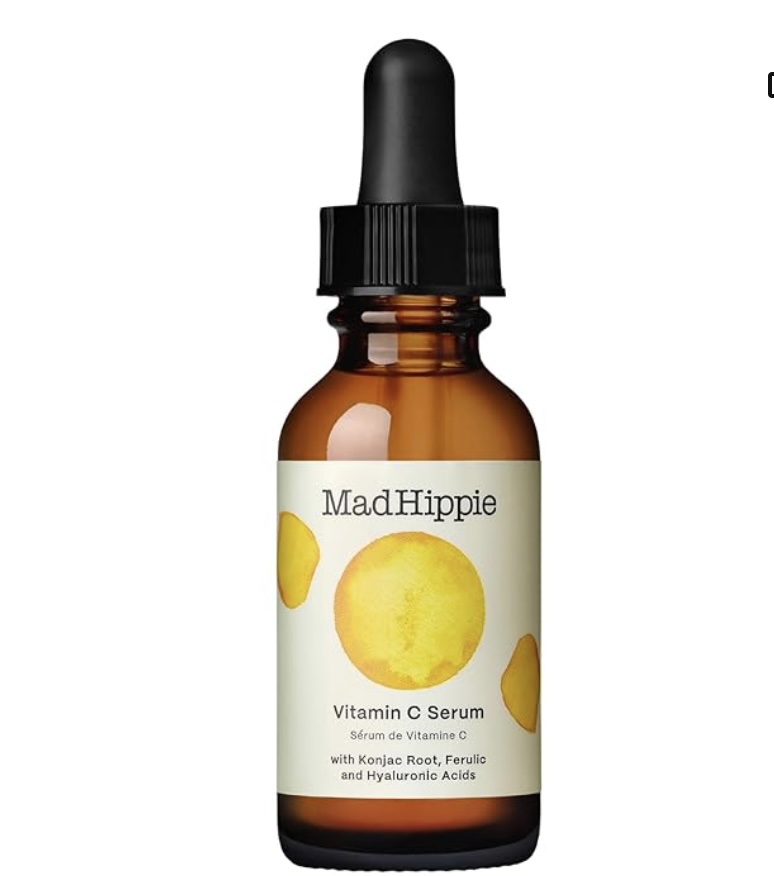
Technically, sodium ascorbyl phosphate is a salt, and less potent than l-ascorbic acid. Think of l-ascorbic acid as a ten-pound weight, and sodium ascorbyl phosphate as a five-pound weight, which makes it lighter, less intense, and less irritating. If you have sensitive skin, this is a great form of vitamin C, yet you won’t see results as quickly as if you use a more potent form. In many cases, brands will add two forms of vitamin C including this one to the mixture, which can be helpful if you are sensitive to one form or another.
What We Love: Mad Hippie Vitamin C Serum uses Sodium Ascorbyl Phosphate and is wonderful for sensitive or acne prone skin. If that’s you, this is a great place to start. Cost $27.
Magnesium Ascorbyl Phosphate (MAP)

Do you have oily skin? Then MAP is the vitamin C for you. As one of the most stable vitamin C derivatives, MAP is hydrating, soothing, and anti-inflammatory. Having said that, its absorption rates are not thoroughly researched, and are less than ascorbic acid. It’s best used in water-based formulas like aloe vera, and works well with niacinamide and in serums and other skin care treatments. You will sometimes find it mixed in serums with other vitamin C derivatives.
What We Love: Babyface Super Strength 15% MAP Magnesium Ascorbyl Phosphate Vitamin C is great for oily and sensitive skin. It’s not as potent as other forms of the ingredient, but if they are oily and/or sensitive, it might do the trick. Cost $26.99.
Sodium Ascorbate

This form of vitamin C falls into the category of mineral salts, and is also a derivative of ascorbic acid. Because it converts into ascorbic acid when applied to the skin, it is less potent and less irritating than a purer form of the vitamin. On the good side, it is very stable when exposed to light and air, unlike more potent forms.
What We Love: Ole Henriksen Banana Bright 15% Vitamin C Dark Spot Serum contains Sodium Ascorbate and is well-known as a stable and non-irritating form of vitamin C. As a less potent form, it benefits sensitive users and those not wanting to totally jump on the vitamin C bandwagon. Cost $56.
Calcium Ascorbate
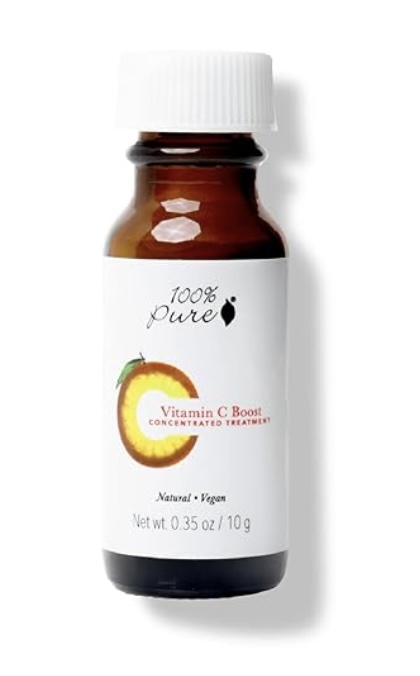
Another mineral salt also called Ester C, calcium ascorbate plays a role in collagen synthesis, tissue and wound repair, and antioxidant defense. It defends against free radicals, promotes collagen production, reduces fine lines, and eliminates dark spots. It has wonderful hydrating benefits, and the calcium strengthens bones, cartilage and tissues. Lastly, because it has a neutral pH, it is non-irritating.
What We Love: 100% Pure Vitamin C Boost contains ascorbic acid, sodium ascorbate, and calcium ascorbate in its vitamin C mixture along with hyaluronic acid. These forms of vitamin C are not as strong, and cater to sensitive and acne prone skin the most. Cost $58.
Ascorbyl Tetraisopalmitate (ATIP)
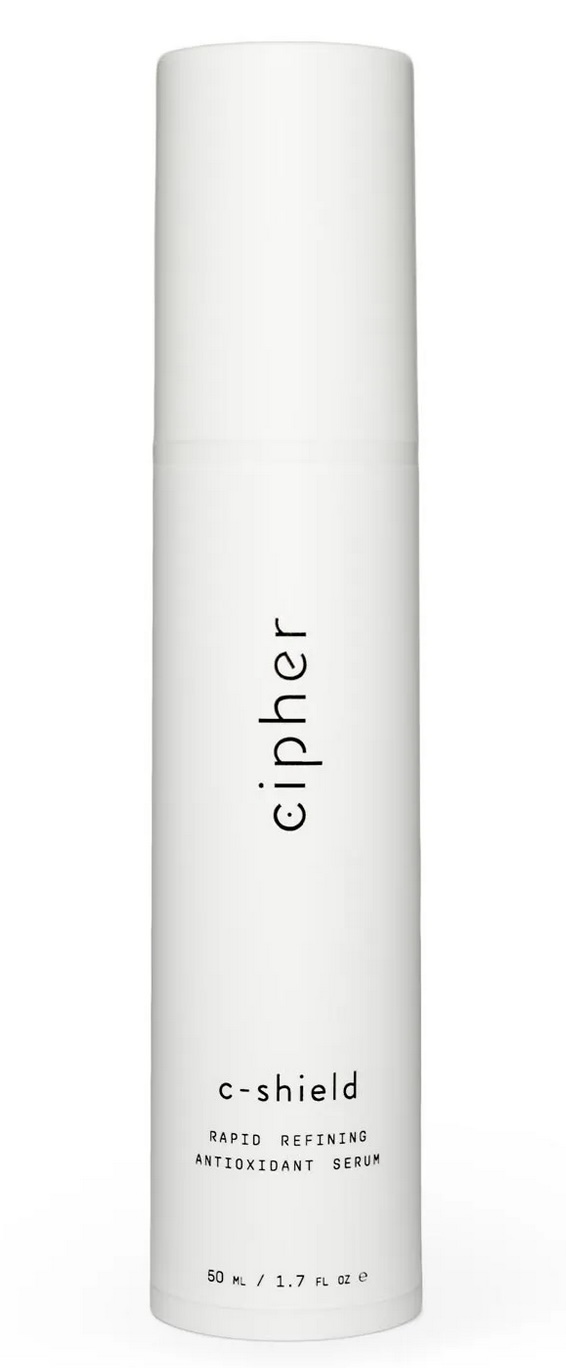
This type of vitamin C when used in skin care is an all-in-one boosting and brightening superstar. It is fat soluble, non-irritating, but stable in light and air. It aids in collagen production, mitigates hyperpigmentation, and improves skin’s texture. As a tetra ester of ascorbic acid and isopalmitic acid, it is a clinically proven oil soluble vitamin C derivative that provides superior percutaneous absorption and effectively converts to free vitamin C in the skin. It brightens, reduces UV-induced cell and DNA damage, provides antioxidant functionality, and boosts collagen synthesis. It is incredibly efficacious and the most expensive on our list.
What We Love: C-Shield Rapid Refining Antioxidant Serum uses this efficacious and non-irritating form of vitamin C. It reduces dark spots, helps with hyperpigmentation, redness, and aging. Cost $178.
Ascorbyl Tetraisopalmitate (ATIP) vs Tetrahexyldecyl Ascorbate (THDA)
It is often cited that ascorbyl tetraisopalmitate (ATIP) and tetrahexyldecyl ascorbate (THDA) are two names for the same thing, but this isn’t the case. They indeed have many similarities, including the same molecular weight, but they are each their own unique chemical.
Both ATIP and THDA are known for their stability compared to pure vitamin C (L-ascorbic acid), which is highly unstable and prone to oxidation.THDA is considered to be more stable than ATIP in formulations, which can lead to a longer shelf life of products containing THDA. Both ATIP and THDA offer antioxidant properties that help protect the skin from free radical damage and environmental stressors.
How you Conquer Shopping for Vitamin C Serum
Armed with the knowledge of the 7 different types of topical vitamin C serums, you now possess the confidence to navigate the sea of skincare products with clarity and purpose.
Imagine this; you return to looking at vitamin C serums, and instead of your eyes glazing over at the multitude of claims, promises, and how “you will lose 20 years upon application of this product,” you flip the bottle over and begin to read the ingredient deck with added confidence.
As you pan down the long list of foreign names, you look for the specific type of vitamin C that you know is best for your skin, and in finding it, you see that it’s listed at number 20 on the deck, meaning that there is so little in the formulation as to make it nearly devoid of efficacy.
With a small smile, you place the bottle back on the shelf, and, grabbing a different bottle, you flip it over. Within 5 minutes, you find a vitamin C serum that has both the type and quantity you feel is best for your skin.
Embrace this newfound empowerment as you embark on your journey to find the perfect vitamin C serum for you. Happy shopping!



Such great info for us skin care people–I knew a lot about C’s but this helped me much further as I wasn’t sure about ATIP now I do.
THX!
Marianne Guzzardo
Hi Marianne, Thank you for your comment and I am so glad the article was helpful! I loved learning all about this subject while writing it. Although it might be a little TMI for some, it helps others.